1813 · Novel of manners / romance
Pride and Prejudice
Pride and Prejudice (1813) is Jane Austen's second published novel and her most famous work. It follows Elizabeth Bennet, the quick-witted second of five sisters, as she navigates courtship, class, and her evolving judgment of the proud Mr. Darcy in Regency-era England.
Few novels open with a sentence as instantly recognizable as “It is a truth universally acknowledged, that a single man in possession of a good fortune, must be in want of a wife.” With that line Austen announces her method: comedy on the surface, economics underneath.
This page is the starting point for everything on Pride and Prejudice on this site. Each section below links to a fuller guide: plot summary, characters, themes, best editions, every screen adaptation, and the full text to read free, chapter by chapter.
Pride and Prejudice at a glance
| Author | Jane Austen, published anonymously |
| Written | October 1796 – August 1797 as First Impressions; revised 1811–12 |
| Published | 28 January 1813, by Thomas Egerton, in three volumes |
| Length | About 122,000 words; 61 chapters |
| Reading time | Eight to ten hours |
| Setting | Hertfordshire, Kent and Derbyshire, early 1810s |
| Heroine | Elizabeth Bennet, aged twenty |
| Hero | Fitzwilliam Darcy, of Pemberley |
| Read it | Free online, chapter by chapter |
What is Pride and Prejudice about?
Mr. and Mrs. Bennet have five daughters and a problem. Their estate, Longbourn, is entailed on the nearest male relative, a clergyman cousin called Mr. Collins, so when Mr. Bennet dies the girls will lose their home. Mrs. Bennet’s solution is to marry them off, and when a rich young man, Mr. Bingley, rents the nearby house of Netherfield, she sees her chance.
Bingley falls for the eldest daughter, Jane, almost at once. His friend Mr. Darcy, who is far richer, makes a very different impression: at the first ball he refuses to dance and calls the second daughter, Elizabeth, merely “tolerable” within her hearing. Elizabeth decides she knows exactly what kind of man he is. Over the following year she meets the charming officer Mr. Wickham, who has a story about Darcy’s cruelty; turns down Mr. Collins; visits her newly married friend Charlotte in Kent; and receives a proposal she does not expect from the last person she would have imagined.
The rest of the novel is about what happens when two proud, intelligent people discover they have both been wrong. For the complete plot, chapter by chapter, see the Pride and Prejudice summary.
From “First Impressions” to publication
Austen drafted the novel as First Impressions between October 1796 and August 1797, when she was just twenty-one. Her father offered it to the publisher Thomas Cadell in November 1797; it was declined by return of post, unread. She revised it substantially around 1811–1812, retitled it, and sold the copyright to Thomas Egerton for £110.
The new title may have come from Fanny Burney’s novel Cecilia (1782), which uses the phrase “pride and prejudice” in capital letters near its end; another novel called First Impressions had also appeared in the meantime. When the first copies arrived at Chawton, Austen called the book “my own darling child” in a letter to her sister Cassandra, and a week later joked that it was “rather too light and bright and sparkling.” It sold well from the start. Egerton brought out a second edition the same year, and the novel has never been out of print since.
Main characters
| Character | Who they are |
|---|---|
| Elizabeth Bennet | The second daughter: twenty, quick, funny and too sure of her own judgement |
| Fitzwilliam Darcy | Owner of Pemberley in Derbyshire, £10,000 a year, proud and reserved |
| Jane Bennet | The eldest sister, beautiful and determined to think well of everyone |
| Mr. Bennet | Clever, sardonic, and happiest in his library away from his family |
| Mrs. Bennet | Nervous, loud and single-minded about getting her daughters married |
| Mary, Kitty and Lydia Bennet | The younger sisters: bookish, easily led, and wild |
| Charles Bingley | Darcy’s good-natured friend, who rents Netherfield |
| Caroline Bingley | His sister, who wants Darcy for herself |
| George Wickham | A charming militia officer with a grudge against Darcy |
| Mr. William Collins | The pompous clergyman cousin who will inherit Longbourn |
| Charlotte Lucas | Elizabeth’s practical friend, who marries Mr. Collins |
| Lady Catherine de Bourgh | Darcy’s aunt and Mr. Collins’s patroness, at Rosings Park |
| Mr. and Mrs. Gardiner | Mrs. Bennet’s sensible brother and his wife, from London |
| Georgiana Darcy | Darcy’s shy younger sister |
The Pride and Prejudice characters guide covers every character, including the ones this table leaves out, and how they are connected.
Where and when it is set
Most of the novel takes place in and around Longbourn, the Bennets’ house in Hertfordshire, a mile from the market town of Meryton, where the militia are quartered for the winter. Netherfield Park, Bingley’s rented house, is three miles away. In the middle of the book Elizabeth travels to Hunsford in Kent, the Collinses’ parsonage beside Lady Catherine’s estate, Rosings. In the third volume she tours Derbyshire with the Gardiners and visits Darcy’s house, Pemberley. London appears mainly as the Gardiners’ address in Gracechurch Street, and Brighton, where the regiment goes for the summer, is offstage but important.
Austen never names a year, but the novel was revised for publication in 1811–12, and scholars who have reconstructed its calendar usually place it across those years. It covers about fifteen months, from Bingley’s arrival in the autumn to the double wedding at the end. For the wider world the novel takes for granted, see when was the Regency era.
Themes
- Pride and prejudice. Both leads have both faults. Darcy’s pride makes him careless of other people’s feelings; Elizabeth’s pride in her own perception makes her prejudiced. The novel’s turning point is her realisation, after Darcy’s letter, that “till this moment I never knew myself.”
- Marriage and money. Almost every marriage in the book is a case study: the Bennets’ mismatch, Charlotte’s clear-eyed bargain with Mr. Collins, Lydia’s elopement, the Gardiners’ happy partnership. Austen never pretends money does not matter.
- Class. Darcy’s first proposal insults Elizabeth’s family as well as flattering her. Lady Catherine’s objections in Chapter 56 put the class question at its bluntest, and Elizabeth’s answer is the novel’s: “He is a gentleman; I am a gentleman’s daughter.”
- Judgement and first impressions. The original title was not an accident. The whole plot turns on characters judging too fast and learning to look again.
Our themes guide develops each of these with quotations and chapter references.
The key chapters
| Chapter | What happens |
|---|---|
| 1 | “It is a truth universally acknowledged…”: Mr. and Mrs. Bennet discuss Bingley |
| 3 | The Meryton assembly: Darcy finds Elizabeth “tolerable” |
| 19 | Mr. Collins proposes |
| 34 | Darcy’s first proposal at Hunsford |
| 35 | Darcy’s letter |
| 43 | Elizabeth visits Pemberley |
| 46 | News of Lydia’s elopement |
| 56 | Lady Catherine confronts Elizabeth |
| 58 | The second proposal |
| 61 | The final chapter: what became of everyone |
Pride and Prejudice on screen
Pride and Prejudice is the most-adapted of Austen’s novels, with more than a dozen screen versions since a lost BBC broadcast in 1938. The two most people know are the 1995 BBC miniseries with Jennifer Ehle and Colin Firth and the 2005 film with Keira Knightley and Matthew Macfadyen. A new six-part Netflix series, with Emma Corrin and Jack Lowden, arrives on 3 December 2026. Our guide to every Pride and Prejudice adaptation compares all of them, back to Greer Garson and Laurence Olivier in 1940.
Which edition to read
Any complete text will do, and the whole novel is free to read on this site. If you want a printed copy, the choice mostly comes down to notes and presentation. Our guide to the best editions compares annotated, illustrated and gift editions.
Why it endures
The marriage plot was hardly new in 1813. What Austen added was a heroine who thinks — and misthinks — in front of us, and a narrative voice (free indirect style) that lets us share Elizabeth’s errors as if they were our own.
It is also the best place to start with Austen. It is shorter than Emma or Mansfield Park, funnier than Sense and Sensibility, and its central couple is the model for two centuries of romantic comedy. See Jane Austen’s books in order for where to go next.
Illustrated by Hugh Thomson (1894)
Four plates from the first illustrated edition, click to enlarge.
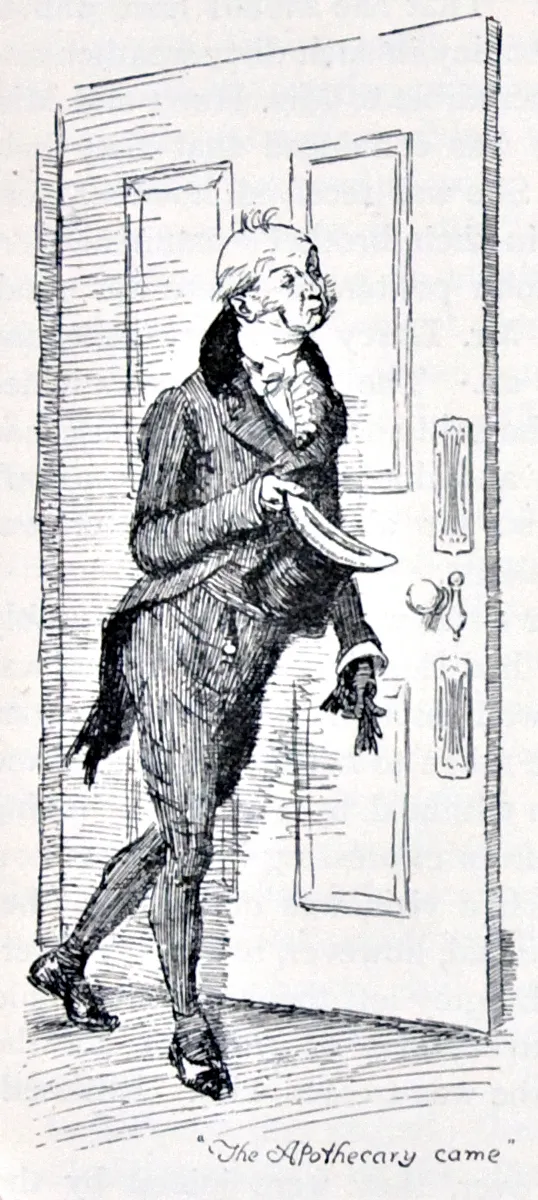
"The apothecary came" — Ch. 7
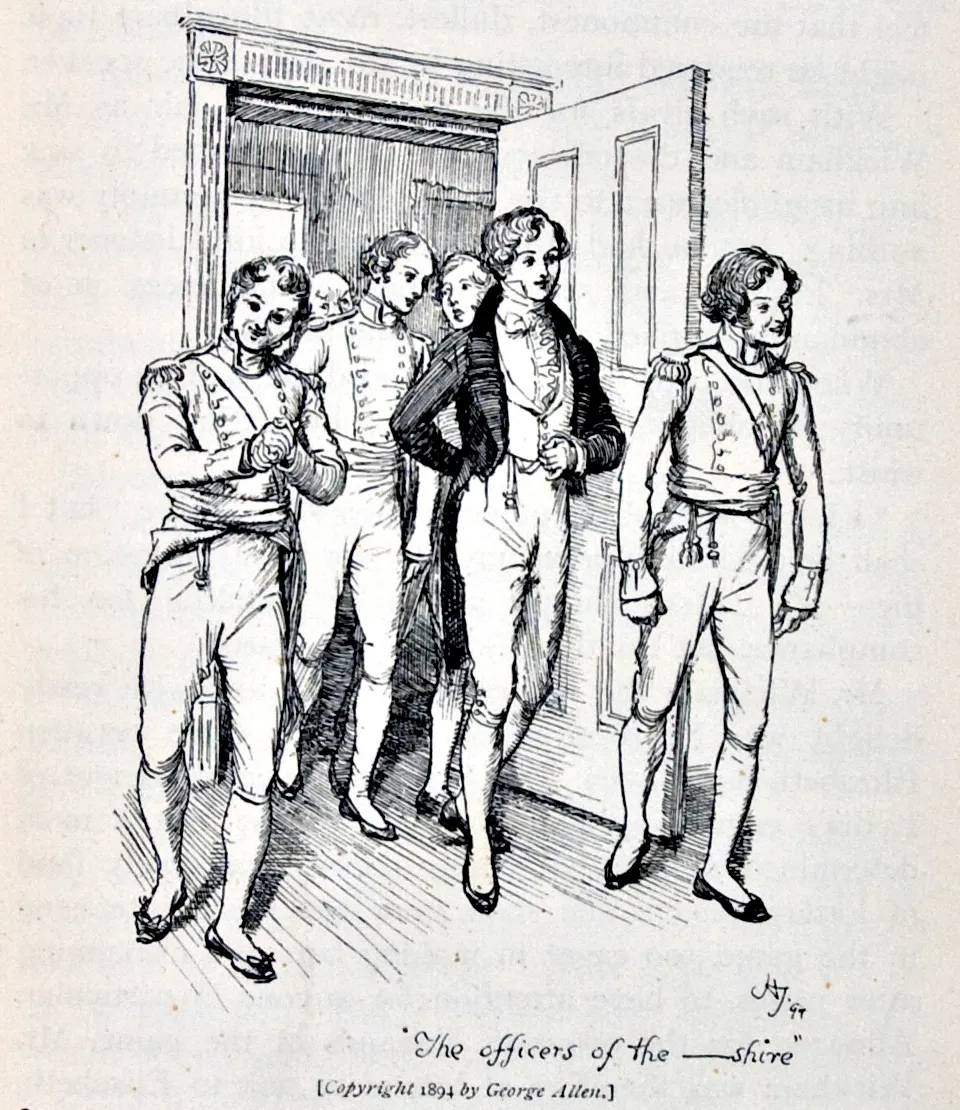
"The officers of the —shire" — Ch. 7
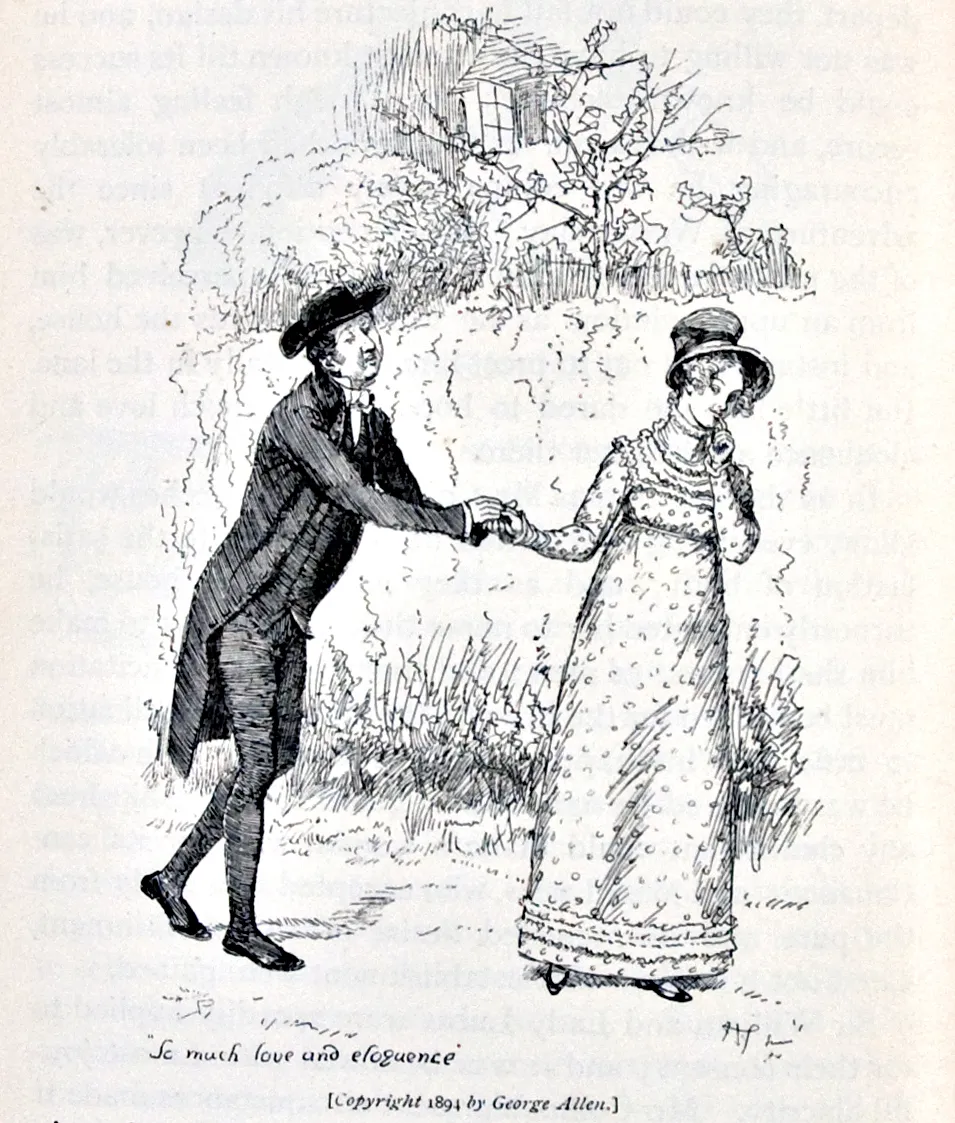
"So much love and eloquence" — Ch. 19
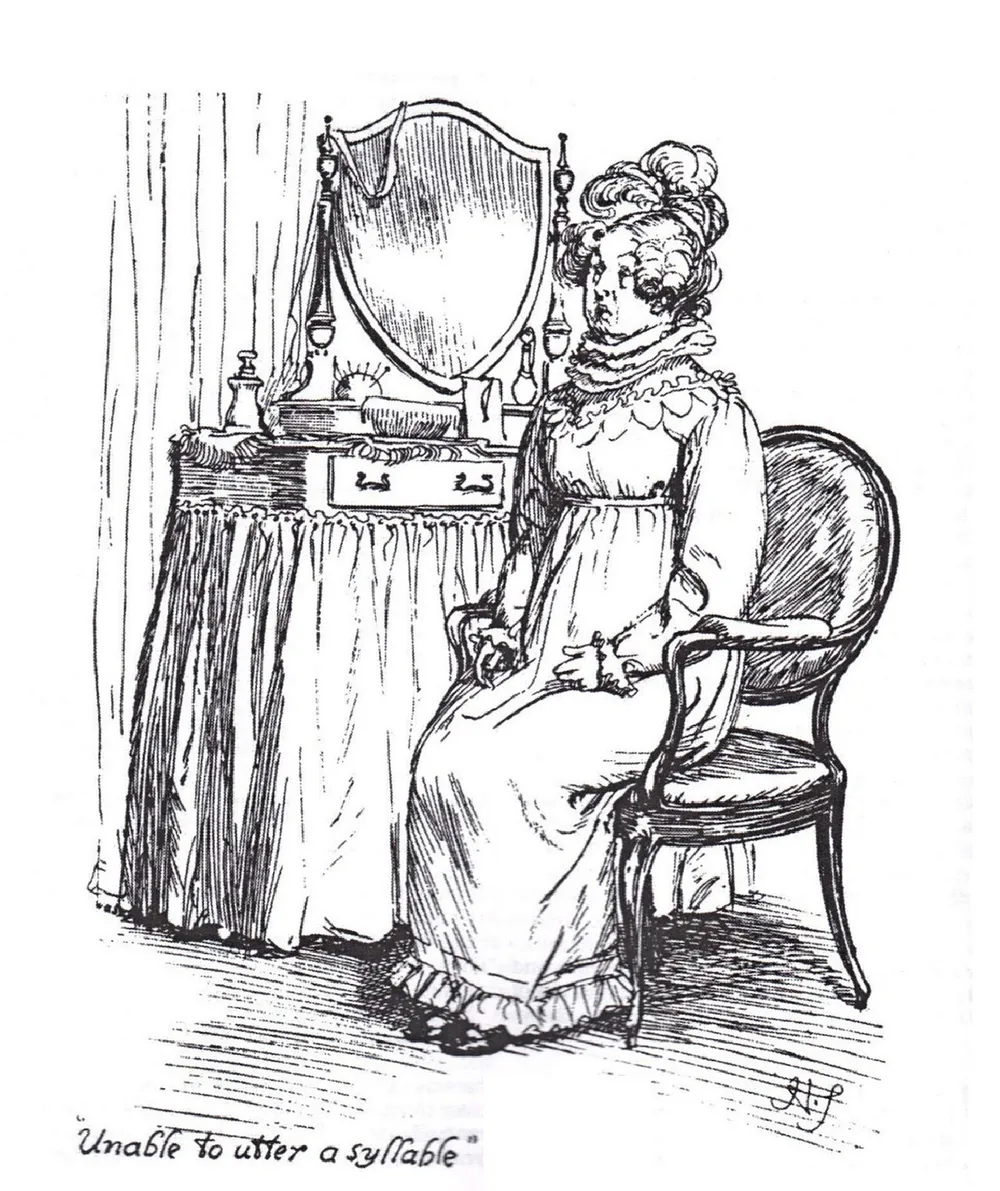
"Unable to utter a syllable" — Ch. 59
Hugh Thomson, George Allen 1894 edition · Public domain
Frequently Asked Questions
Who wrote Pride and Prejudice?
Jane Austen. She drafted it as "First Impressions" in 1796–97, at the age of twenty-one, and revised it heavily before publication in 1813. It appeared anonymously, credited only to "the Author of Sense and Sensibility."
When was Pride and Prejudice published?
Pride and Prejudice was published on 28 January 1813 by Thomas Egerton. Austen had drafted it as "First Impressions" between 1796 and 1797.
What is Pride and Prejudice about?
The novel follows Elizabeth Bennet and Mr. Darcy, whose mutual misjudgments — her prejudice, his pride — must be overcome before they can marry. It is both a love story and a sharp comedy of manners about money, class, and marriage.
When and where is Pride and Prejudice set?
In the English countryside of the early 1810s, over about fifteen months. The Bennets live at Longbourn in Hertfordshire, near the market town of Meryton; the story moves to Hunsford in Kent and to Pemberley in Derbyshire.
How many chapters are in Pride and Prejudice?
Sixty-one, originally published in three volumes of 23, 19 and 19 chapters. The novel runs to about 122,000 words, or eight to ten hours of reading.
What are the main themes of Pride and Prejudice?
Pride and prejudice themselves, as faults of judgment rather than simple vices; marriage and money; class and social mobility; and the difficulty of reading other people accurately. Our themes guide covers each in depth.
Why is Pride and Prejudice a classic?
Its opening sentence is among the most quoted in English literature, its heroine remains one of fiction's most beloved, and its irony and social observation have kept it continuously in print for over two centuries.